A new world order?
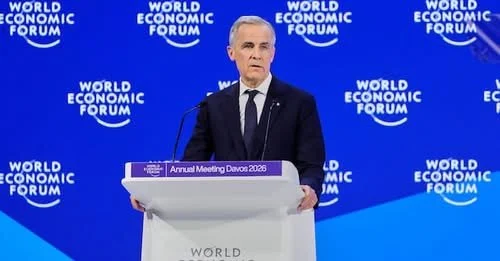
The Canadian Prime Minister, Mark Carney, gave a speech to the World Economic Forum at Davos on 20th January 2026. In it, he expressed his concerns about how the rules-based systems and traditional alliances that have governed the world in the post-second world war era are breaking down. Indeed, he used the phrase that the world is ‘in the midst of rupture, not a transition’. Moreover, he opined that the ‘old world order is not coming back’. He observed that we now live in an increasingly bi-polarised world of America and China where geopolitics is increasingly driven by ‘might is right’. By ‘might is right’ is meant not just military but economic pressure, with great powers ‘… using economic integration as weapons, tariffs as leverage, financial infrastructure as coercion, supply chains as vulnerabilities to be exploited.’
Carney probably had America in mind. After all, in recent times prior to the speech, the American President Donald Trump had stated that he wanted Canada to be the 51st state of the USA - threatening Canada with economic force such as tariffs - and that Greenland should be acquired for national security reasons. In addition, there has been increasing friction between America and the EU. Trump has stated that the only constraint on his actions in the international arena is his own sense of morality, not international law. Perhaps most dramatically, in the context of Greenland, Carney referred to Article 5 of the NATO Alliance whereby an attack on one is considered an attack on all; in other words, if America tried to seize Greenland then Canada and other NATO countries would come to Greenland’s aid. This was most extraordinary, for America is also a member of NATO: who would have thought that when NATO was founded that it would have to protect itself against one of its own members rather than an external enemy?
Carney called for middle countries, such as Canada, Australia, Argentina, South Korea and Brazil - influential but not major players compared to the five permanent members of the United Nations Security Council - to group together so that they have safety in numbers vis-à-vis the superpowers.
Singapore’s foreign policy has been not to take sides with one of the superpowers, that is, non-alignment, but to engage in dialogue and maintain cordial relations with all. Moreover, Singapore has been strongly committed to the rule of international law and various international agreements.

Soft power is the ability of a country to influence international affairs through cultural, reputational and persuasive means rather than the brute hard power of military or economic ways.