The Prisoner’s Dilemma
Imagine two prisoners who are rational and self-interested. The Police catch them on a minor offence. The Police suspect that they were also involved in a more serious offence but have no evidence for this. The two prisoners are taken respectively to two cells. There is no opportunity for the two prisoners to communicate with each other.
The Police offer a deal to each prisoner. If a prisoner testifies that the other prisoner committed the serious offence and the other stays silent, he will be released whilst the other prisoner will serve 3 years. If both prisoners testify against each other, they will both serve 2 years. If both prisoners stay silent, they will serve 1 year (for the minor offence).
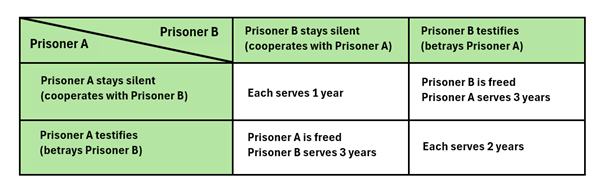
What should each prisoner do?
The best outcome for the group is that the two prisoners stay silent. However, each prisoner cannot be sure that the other will not betray him. Therefore, the best course of action for the individual is to testify: if the other stays silent, he will be released and freedom is better than 1 year for the minor crime; if the other testifies, he will serve 2 years and two years is better than 3 years; if he stays silent but the other testifies, he will serve 3 years, which is the worst outcome.
This Prisoner’s Dilemma helps to illustrate the difficult in securing cooperation; that is, there is a tension between what is better for the group compared to the individual. This can be applicable to a variety of scenarios such as countries cooperating to fight climate change or competitive companies offering discounts in a market.




It is often claimed that you cannot prove a negative; that is, you cannot prove that some entity does not exist.